
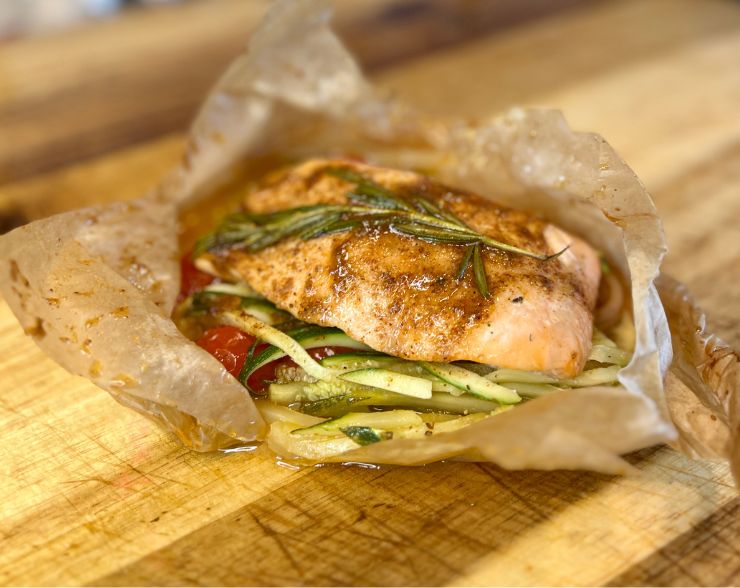
Why You’ll Love This Salmon en Papillote Recipe
The day after I made my Homemade BBQ Butter, I opened the refrigerator, looked at that beautiful roll of butter, and immediately thought, “That would be incredible on salmon.”
Salmon has always been one of my favorite proteins because it doesn’t need much to make an amazing meal. I wanted the BBQ butter to be the star of the dish, and wrapping everything in parchment paper turned out to be the perfect way to make that happen. As the salmon bakes, the butter melts into the vegetables, creating a rich, flavorful sauce right inside the packet.
If you’ve never cooked en papillote before, don’t let the French name intimidate you. It simply means “in parchment.” The parchment paper traps the steam, gently cooking the salmon and vegetables while locking in moisture and flavor.
What I think you’ll love most about this technique is how versatile it is. Once you understand the method, you can change the vegetables with the seasons, use different herbs, experiment with compound butters, or even swap the salmon for another fish, shrimp, or chicken. It’s one of those cooking techniques you’ll find yourself using again and again because the possibilities are nearly endless.
What Is Salmon en Papillote?
En papillote is a classic French cooking technique where food is wrapped in parchment paper and baked. As the ingredients cook, the parchment traps the steam inside the packet, gently cooking everything together.
The salmon stays incredibly moist while the vegetables release their juices and the BBQ butter melts into a rich sauce. Because everything cooks together in the same packet, every bite is infused with the flavors of the lemon, shallots, rosemary, and vegetables.
It may sound fancy, but it’s actually one of the easiest and most forgiving ways to cook fish.
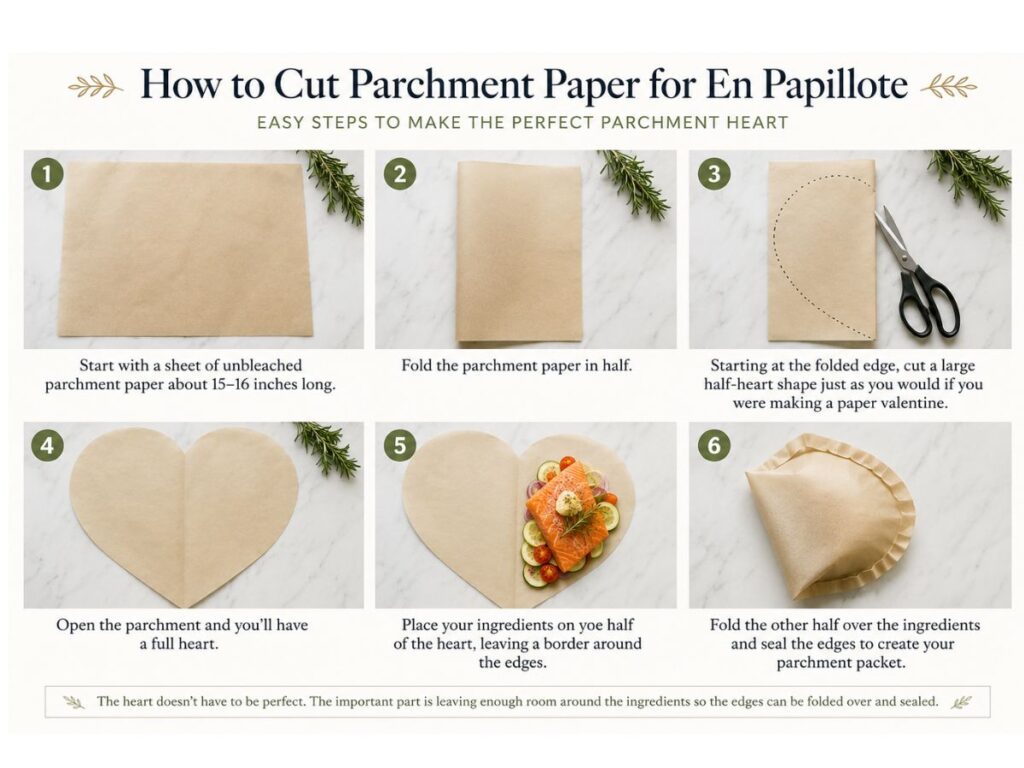
How to Cut Parchment Paper for En Papillote
If you’ve never made a parchment packet before, don’t worry. It’s much easier than it looks.
Start with a sheet of unbleached parchment paper about 15 to 16 inches long. Fold it in half, then starting at the folded edge, cut a large half-heart shape, just as you would if you were making a paper valentine. Open the parchment and you’ll have a full heart.
The heart doesn’t have to be perfect. The important part is leaving enough room around the ingredients so the edges can be folded over and sealed.
(Insert step-by-step photos showing how to cut the parchment heart.)
How to Seal the Parchment Packet
After the salmon and vegetables have been arranged on one half of the parchment heart, fold the empty half over the top.
Beginning near the top of the heart, make a small fold along the edge of the parchment. Continue making small overlapping folds all the way around the packet, pressing each fold firmly before making the next one. When you reach the bottom, twist the pointed end to finish sealing the packet.
The folds don’t need to be perfect. The goal is simply to create a tight seal that keeps the steam inside while the salmon cooks.
Why I Use Unbleached Parchment Paper
Whenever possible, I use unbleached parchment paper. It performs just as well in the oven while avoiding the unnecessary bleaching process.
If all you have is regular parchment paper, it will still work just fine. Just be sure you’re using parchment paper and not wax paper, which isn’t designed for oven temperatures.
Variations to Try
Once you learn the technique, it’s easy to make this recipe your own.
Instead of zucchini, try asparagus, green beans, mushrooms, spinach, fennel, or thinly sliced potatoes. Change the rosemary for thyme, dill, or tarragon. Try a garlic herb butter, lemon butter, or another favorite compound butter.
The same technique also works beautifully with cod, halibut, shrimp, chicken breasts, or pork tenderloin medallions.
Learning how to cook en papillote opens the door to countless flavor combinations throughout the year.
Salmon en Papillote with BBQ Butter
Equipment
Ingredients
- 2 large sheets unbleached parchment paper
- Avocado oil or extra virgin olive oil
- 4 lemon rounds, about ¼-inch thick
- 1 small shallot, thinly sliced
- 1 cup cherry tomatoes cut in half
- 1 zucchini, thinly sliced
- Kosher salt, to taste
- Freshly ground white pepper, to taste
- 2 salmon fillets (about 6 ounces each)
- Homemade BBQ Butter
- 2 small sprigs fresh rosemary
- 2 tsp dry white wine (optional)
Instructions
- Preheat the oven to 425°F.Fold each sheet of parchment paper in half. Starting at the folded edge, cut each sheet into a large heart shape. Open the parchment hearts and lightly coat one half of each with avocado oil or extra virgin olive oil. If this is your first time making parchment packets, the step-by-step photos below will walk you through cutting and folding them.Place 2 lemon rounds in the center of one half of each parchment heart, leaving enough room around the edges to fold and seal the packet. Top the lemons with the shallots, cherry tomatoes, and zucchini. Lightly season the vegetables with kosher salt and white pepper.Place one salmon fillet on top of the vegetables and season with additional kosher salt and white pepper.Top each fillet with 1–2 tablespoons of Homemade BBQ Butter and a sprig of fresh rosemary. If using, drizzle 1 teaspoon of white wine around the vegetables, not over the butter.Fold the empty half of the parchment over the salmon. Beginning at the top near the fold, make a small fold along the edge of the parchment. Continue making small overlapping folds all the way around the edge, pressing each fold firmly to create a tightly sealed packet. Twist the pointed end of the parchment to secure the seal.Place the packets on a baking sheet and bake for 10–12 minutes, depending on the thickness of the salmon.Allow the packets to rest for 2–3 minutes before carefully opening. Remove the rosemary sprigs and serve immediately.
Notes
- Use parchment hearts large enough to leave a generous border around the ingredients so the packets can be sealed easily.A tightly sealed packet traps the steam, gently cooking the salmon while creating a flavorful sauce from the butter, vegetables, and juices.Cooking time may vary depending on the thickness of the salmon. Thicker fillets may need an additional minute or two.Serve with rice, roasted potatoes, crusty bread, or another favorite side to soak up the buttery sauce.
