Food Truth Series: What Are “Natural Flavors,” Really?
Pick up a sparkling water, granola bar, protein powder, salad dressing, or carton of nut milk, and you may find “natural flavors” on the ingredient list.
It sounds simple. Maybe a little fruit extract, vanilla, or something squeezed from a citrus peel.
But those two words can represent a complicated manufactured mixture—and the label doesn’t give you the complete formula.
A Misleading Name
According to the FDA, natural flavors contain flavoring substances derived from qualifying plant or animal sources. Those sources include fruits, vegetables, herbs, spices, bark, roots, dairy, meat, and fermentation products.
But a natural starting point does not mean a minimally processed finished ingredient. The definition allows extraction, distillation, heating, and the use of enzymes to obtain flavoring compounds. www.law.cornell.edu
“Natural” tells you something about where the flavor originated. It does not tell you everything that happened afterward—or everything included in the finished mixture.
What Can Be Included Under “Natural Flavors”?
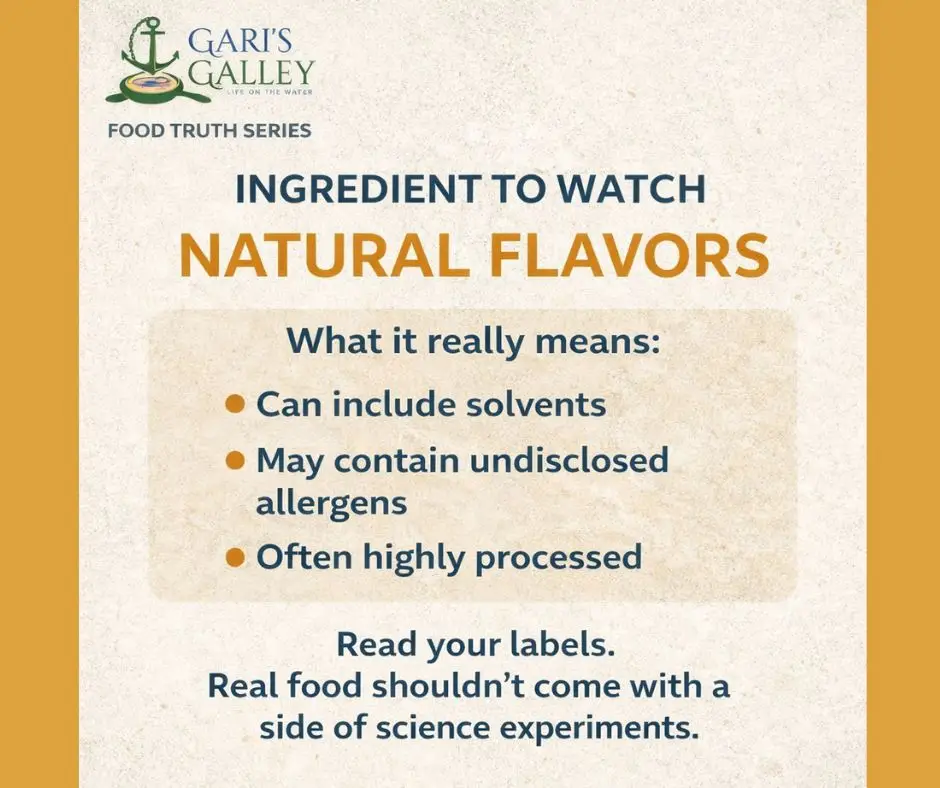
Those two words can represent a mixture of as many as 100 components, including flavoring substances, solvents, emulsifiers, and preservatives, according to the Environmental Working Group. www.ewg.org
Depending on the formula, that mixture may include:
• Flavoring compounds derived from plant or animal sources
• Highly refined compounds extracted from natural materials
• Solvents used to extract or dissolve flavor compounds
• Carrier agents such as propylene glycol
• Emulsifiers that help ingredients mix together
• Preservatives that protect the flavor mixture
Conventional natural flavor mixtures may use synthetic supporting ingredients. USDA organic standards place additional restrictions on synthetic solvents, carrier systems, and artificial preservatives.
Why Doesn’t the Label List Everything?
U.S. labeling rules allow flavoring components to be listed collectively as “natural flavors,” rather than naming each one.
Certain supporting ingredients can also be omitted when they meet the requirements for incidental additives, including being present at insignificant levels without a technical or functional effect in the finished food. www.law.cornell.edu
These formulas may be proprietary, but the permission to leave components unnamed comes from the labeling rules.
A company can follow those rules without giving you the complete flavor formula.
You see two words. You don’t see the full mixture behind them.
Why Some People Choose to Avoid Them
For people managing food sensitivities—or simply wanting to know exactly what they’re eating—natural flavors can leave unanswered questions:
• What ingredients make up the flavor mixture?
• What plant or animal sources were used?
• Were solvents, carriers, or preservatives included?
• Does the mixture contain something they’re trying to avoid?
Without the complete formula, investigating a suspected food trigger can be more difficult. The label may not provide enough information to identify an ingredient someone wants to avoid.
For those who prefer transparency in their food, that lack of clarity is reason enough to choose something else.
What About Food Allergens?
Major food allergens generally must still be disclosed when present in a natural flavor. For example, a flavor containing peanut protein does not escape peanut labeling simply because it is listed as “natural flavors.” www.fda.gov
But major-allergen disclosure is not a complete ingredient breakdown. It does not identify every source, processing material, or component that might matter to an individual shopper.
Does Organic Make a Difference?
Yes. USDA organic standards place additional restrictions on flavor ingredients. Qualifying flavors cannot be produced using synthetic solvents and carrier systems or contain artificial preservatives. www.ams.usda.gov
That is a meaningful difference when choosing between products.
But those restrictions don’t turn “natural flavors” into a complete ingredient list. Knowing that a formula meets organic requirements and knowing every component in that formula are different things.
Why I Choose to Avoid Natural Flavors
I want to know what I’m bringing into my kitchen. When a label gives me “natural flavors” without the complete formula, I can’t evaluate that mixture for myself.
That lack of transparency is enough for me to leave a product on the shelf.
Scratch cooking gives me more control. I can add fruit, citrus zest, vanilla, herbs, and spices—and know what I used to create the flavor.
If a flavor mixture can contain dozens of components, I want more than two words to tell me what I’m eating.