
The Dangers of Iodized Table Salt: What You Should Know
Salt is one of the simplest, most essential ingredients in the kitchen. We use it to season food, preserve harvests, and bring out the best in every bite. But not all salt is created equal. For decades, iodized table salt has been promoted as a health necessity — the quick fix to iodine deficiency. While iodine supplementation played an important role in the early 20th century, modern diets look very different today, and many people are rethinking whether iodized table salt is really the best option.
Here’s an in-depth look at the potential downsides of iodized table salt — and why cleaner, unrefined alternatives may be a better choice.
What Is Iodized Table Salt?
Iodized salt starts as refined table salt, a highly processed product that is nearly pure sodium chloride. During refining, natural trace minerals are stripped away. Manufacturers then add iodine (usually as potassium iodide or potassium iodate) along with anti-caking agents such as calcium silicate or sodium aluminosilicate to keep the salt free-flowing.
This practice began in the early 1900s as a public health measure to prevent iodine deficiency, which caused widespread goiter in some parts of the U.S. At the time, it was an effective solution. But with modern diets that include seafood, dairy, and eggs — all natural sources of iodine — the picture has changed.
Potential Dangers and Concerns
1. Excessive Iodine Intake
Iodine is essential for thyroid health, but too much can cause harm. Overconsumption has been linked to both hyperthyroidism and hypothyroidism, especially in people with pre-existing thyroid sensitivities. With iodine added to salt, present in supplements, and found in processed foods, it’s easier than ever to overdo it.
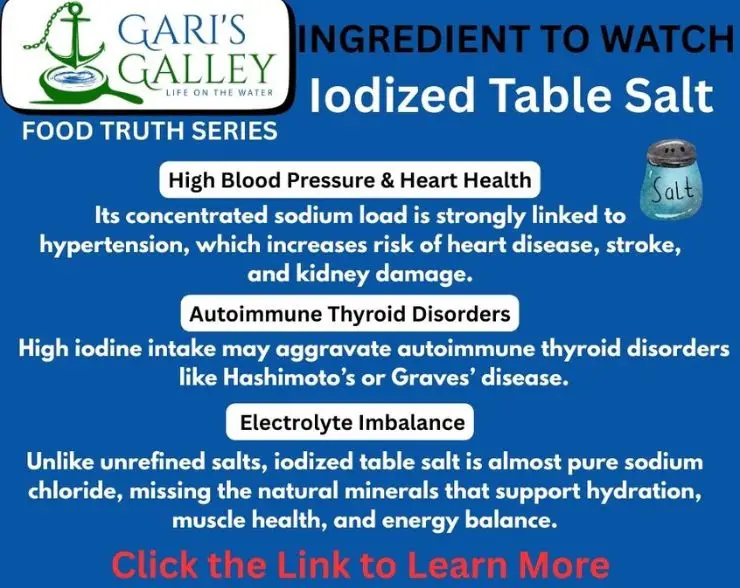
2. High Blood Pressure & Heart Health
Iodized salt is almost pure sodium chloride. Excess sodium intake has been directly tied to elevated blood pressure, which increases the risk of heart disease, stroke, and kidney damage. Because iodized salt is cheap and used heavily in processed foods, it’s a major driver of excessive sodium consumption.
3. Impact on Taste Buds
Refined iodized salt delivers a flat, one-dimensional flavor. Over time, this dulls your palate, so you end up adding more and more salt just to taste the same level of seasoning. In contrast, unrefined salts (like sea salt or Redmond Real Salt) contain trace minerals that give food a fuller, more complex flavor — meaning you can often use less and still feel satisfied.
4. Additives & Anti-Caking Agents
To keep iodized salt from clumping, manufacturers add compounds such as sodium aluminosilicate or calcium silicate. While deemed safe in small amounts, some people prefer to avoid these synthetic additives — especially when clean, natural salts are available without them.
5. Autoimmune Thyroid Disorders
There’s evidence that high iodine intake can worsen autoimmune thyroid conditions such as Hashimoto’s or Graves’ disease. For people with these conditions, iodized salt may do more harm than good.
6. Environmental & Ethical Concerns
Industrial salt mining and refining can disrupt ecosystems and contribute to pollution. Unrefined salts, often harvested using traditional or less invasive methods, tend to be more environmentally sustainable.
7. Digestive & Sensitivity Issues
Some individuals report bloating or mild stomach upset when consuming iodized table salt, likely due to its additives or the body’s reaction to excess iodine. Others experience skin breakouts or sensitivities when their iodine intake is too high.
8. Electrolyte Imbalance
Because iodized salt is almost pure sodium chloride, it doesn’t supply the trace minerals (like magnesium, potassium, or calcium) that help balance electrolytes. Over-reliance on refined salt without these minerals can affect hydration, muscle health, and energy levels.
Cleaner Alternatives
The good news? There are plenty of simple, additive-free alternatives. Unrefined salts — such as sea salt, Redmond Real Salt, or Himalayan pink salt — provide trace minerals, complex flavor, and no unnecessary additives.
And what about iodine? It’s a natural element that travels through soil and water, eventually concentrating in the ocean. That’s why seafood and sea plants are some of the richest iodine sources — shrimp, fish, and especially seaweed all provide significant amounts. For anyone who feels they may be iodine deficient, a cleaner option is to use pure kelp-derived iodine drops rather than relying on iodized table salt.
Paired with a balanced diet that includes these natural sources, most people don’t need iodized salt to meet their iodine needs.
Final Thoughts
Iodized table salt had its place in history as a quick fix for iodine deficiency. But today, the risks — from high blood pressure and thyroid disruption to taste bud fatigue and additive exposure — outweigh the benefits for many people. Salt should be simple, clean, and pure. By reaching for unrefined, mineral-rich salts, you can season your food with confidence and skip the processed blue canister for good.