
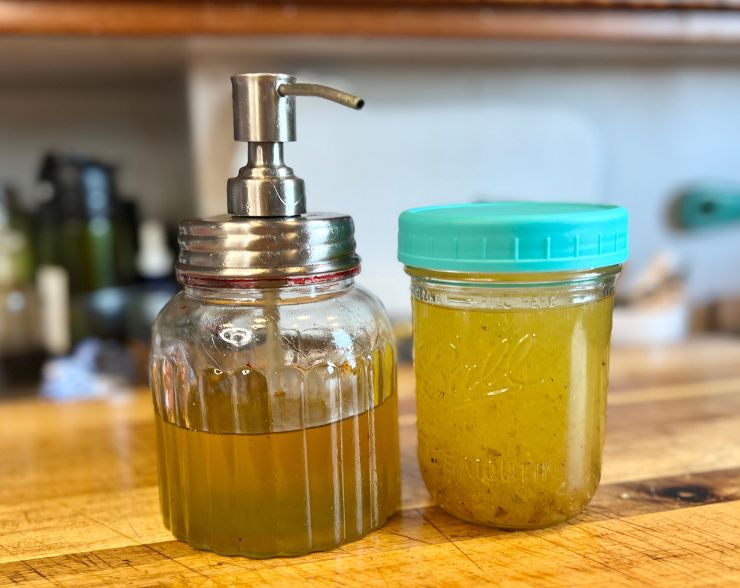
A Slow Infusion Worth the Wait
Nourish Facial Oil is one of those things I always have in the works. Made with castor oil, jojoba oil, frankincense resin, and myrrh resin, it takes only a few minutes to put together, but then time does the rest of the work.
I let mine infuse for at least six weeks, but it can continue infusing for up to six months. In fact, the longer I can leave it, the better. Once you get into a rotation, the wait really isn’t an issue. When the bottle I use every day is empty, I strain the jar that has been infusing and immediately start another batch.
I use Nourish Facial Oil every night before bed, massaging a small amount into my face and neck. While the face is where I especially love using it, this nourishing blend can be used anywhere your skin needs a little extra moisture and care.
Â
Why Castor Oil?
Castor oil is a rich, deeply moisturizing oil and the foundation of my Nourish Facial Oil. What makes castor oil particularly interesting is its exceptionally high concentration of ricinoleic acid, a fatty acid that gives castor oil many of its unique properties.
Ricinoleic acid helps soften and condition the skin while helping reduce moisture loss. Castor oil is also known for its ability to penetrate the outer layers of the skin rather than simply sitting on the surface.
Because castor oil is naturally thick and rich, pairing it with jojoba oil creates a blend that I find much more enjoyable for everyday use, especially on my face.
Â
Why Jojoba Oil?
Despite its name, jojoba oil is technically a liquid wax. Its wax esters are similar in structure to those found in our skin’s natural sebum, which is one reason jojoba is such a popular ingredient in skincare.
It is lightweight, absorbs beautifully, and helps soften and condition the skin without leaving the finished blend feeling as heavy as straight castor oil.
Jojoba is also naturally very stable and resistant to oxidation, making it an excellent partner for a facial oil that may spend several months infusing before it is strained and used.
Â
The Benefits of Frankincense Resin
Frankincense has been valued for centuries and continues to be a popular ingredient in natural skincare. The resin contains a variety of naturally occurring compounds, including aromatic compounds and boswellic acids.
Boswellic acids have been studied for their anti-inflammatory properties, while other compounds found in frankincense have demonstrated antioxidant and antimicrobial activity. Research into frankincense and skin health is ongoing, but these properties, along with its long history of traditional use, are among the reasons I choose to include it in my facial oil.
Frankincense is also often associated with supporting the skin’s natural repair processes and maintaining healthy-looking skin. I don’t look at any single ingredient as a miracle solution, but I love what frankincense brings to this nourishing blend.
What Myrrh Brings to the Blend
Frankincense and myrrh have a long history of being used together, and myrrh brings its own interesting properties to this facial oil.
Myrrh contains naturally occurring antioxidant, anti-inflammatory, and antimicrobial compounds. It has also been studied for its potential role in supporting normal wound healing and the skin’s natural repair processes.
For me, it makes a natural partner for frankincense in a slow-infused skincare oil. It also adds its characteristic deep, earthy aroma to the finished infusion.
Â
Why I Use Whole Resin Instead of Essential Oils
You could certainly make a quicker version of a frankincense and myrrh facial oil using properly diluted essential oils. I prefer using the actual resins and allowing them to slowly infuse into the castor and jojoba oils.
One reason is that I enjoy starting with the whole ingredient. Essential oils contain the concentrated volatile aromatic compounds that are extracted during distillation, while the whole resin contains a broader range of naturally occurring constituents.
I also like knowing exactly what I am starting with. Not all essential oils are created equal. The quality can vary tremendously depending on the plant species, where it was grown, how the oil was distilled and stored, and the standards of the company producing it. Finding essential oils that I feel confident using requires research and a supplier I truly trust.
There is absolutely nothing wrong with choosing a high-quality essential oil. I simply prefer working with the whole frankincense and myrrh resins and giving them plenty of time to slowly infuse.
Giving the Resins Time to Infuse
For your first batch, I recommend giving the frankincense and myrrh at least six weeks to infuse into the oils. If you can leave it longer, you certainly can. Mine may infuse for several months and sometimes as long as six months.
I keep the jar in a dark place under my bathroom sink and flip it every once in a while to redistribute the ground resin.
Once you begin using your first batch, keeping the rotation going is easy. As soon as I strain one jar, I start another. That way, while I’m using one bottle, the next batch is already slowly infusing.
Straining Your Nourish Facial Oil
Because the frankincense and myrrh are ground before being added to the oils, I strain the finished infusion twice.
The first strain through a fine-mesh strainer catches the larger pieces of resin. I then strain the oil again through tightly woven cheesecloth to catch the finer particles. If your cheesecloth has a looser weave, you may need to use several layers.
Once strained, the oil is ready to transfer to a clean bottle or jar.
Making Nourish Facial Oil Part of Your Routine
I especially recommend Nourish Facial Oil for daily use on the face and neck. I use mine at night before bed, massaging a small amount into clean skin and letting it absorb overnight.
But despite the name, it isn’t limited to your face. You can massage it into your hands, arms, chest, or anywhere else your skin could use a little extra nourishment.
I keep my everyday bottle right on my vanity with the rest of my skincare products. There’s no need to hide the finished oil away in a dark cabinet between every use; simply keep the bottle tightly closed and out of direct sunlight.
With just four thoughtfully chosen ingredients and a little patience, Nourish Facial Oil has become a regular part of my nightly skincare routine.
Nourish Facial Oil
Ingredients
- 1 cup castor oil
- 1 cup jojoba oil
- 1 tbsp frankincense resin, finely ground
- 1 tbsp myrrh resin, finely ground
Instructions
- Grind the frankincense and myrrh resins into a fine consistency using a mortar and pestle or your preferred method for grinding resins.Add the ground frankincense and myrrh to a clean glass jar. Pour in the castor oil and jojoba oil and stir well to combine.Cover the jar tightly and store it in a dark place, such as under a bathroom sink or inside a cabinet, for at least 6 weeks. Every once in a while, gently turn or flip the jar to redistribute the ground resins throughout the oils. The oil can continue infusing for up to 6 months, and the longer it infuses, the better.When you are ready to use the oil, strain it first through a fine-mesh strainer to remove the larger pieces of resin. Strain it a second time through tightly woven cheesecloth to remove the finer particles. If using a looser-weave cheesecloth, use several layers.Transfer the strained oil to a clean glass bottle or jar and keep tightly covered.Apply a small amount to clean skin and gently massage it in. I especially recommend using Nourish Facial Oil daily on your face and neck. I apply mine at night before bed, but it can also be used anywhere your skin needs a little extra nourishment.
Notes
- For your first batch, allow the oil to infuse for at least 6 weeks before straining. After that, it is easy to keep a continuous rotation going. When my bottle of Nourish Facial Oil that I use daily is empty, I strain the batch that has been infusing and immediately start a new one. This allows each batch to infuse for several months, up to 6 months, while always having finished oil ready to use.Each ingredient in Nourish Facial Oil was chosen for a reason. Read the full post for a closer look at castor oil, jojoba oil, frankincense resin, and myrrh resin and the benefits each one brings to your skincare routine.StorageStore the finished Nourish Facial Oil in a clean, tightly covered bottle or jar away from direct sunlight. It can be kept with your other daily skincare products on your vanity or bathroom counter as long as it is not sitting in direct sunlight.
