
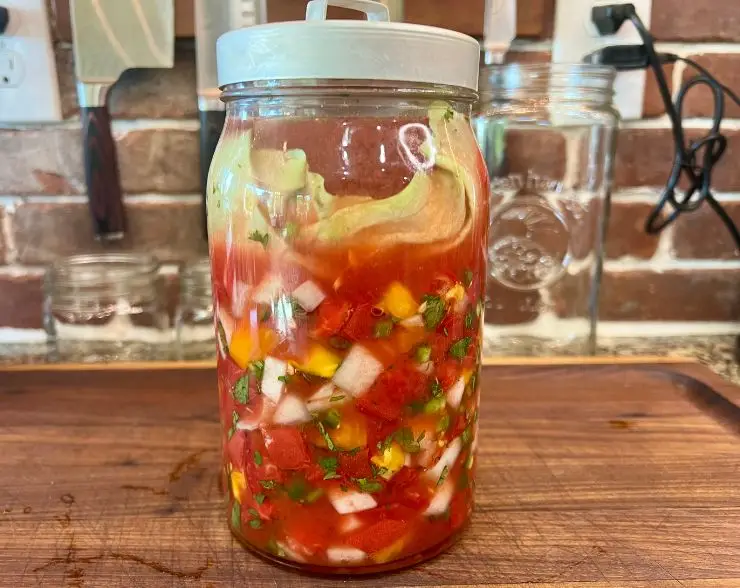
Fermented Salsa
Fermented salsa is a living, probiotic-rich condiment that brings bright flavor and gut-healthy benefits. Unlike canned or vinegar-based salsas, this version relies on natural fermentation. Salt draws liquid from the vegetables and creates an environment where beneficial lactic acid bacteria thrive, preserving the salsa and giving it that pleasant tang.
Equipment
Ingredients
- 6 medium ripe tomatoes, diced
- 1 small onion, diced
- 1-3 jalapeños or serrano peppers, diced (adjust to taste)
- 2-3 cloves garlic, minced
- 1 cup fresh cilantro, chopped
- Juice of 1 lime
Salt (choose one method):
- By Measure: 1 ½ tablespoons Redmond Real Salt
- By Weight: Weigh the prepared vegetables in grams. Multiply that number by 0.02 (2%). The result is how many grams of salt to use.Example: If your vegetables weigh 1,000 g, multiply 1,000 × 0.02 = 20 g salt.
Instructions
- Prepare the vegetables.Dice the tomatoes, onion, and peppers. Mince the garlic and chop the cilantro. Place everything in a large mixing bowl with the lime juice.Add the salt.Choose your method and sprinkle the salt evenly over the vegetables. Stir thoroughly to coat all surfaces.Draw out the brine.Let the salted mixture sit for about 10 minutes, stirring once or twice as it rests. The salt will pull liquid from the tomatoes and other vegetables, creating a natural brine.Check the flavor: Taste the mixture before packing it into jars. It should be pleasantly salty, like a well-seasoned dish, but never harsh or overwhelming.Pack into the jar.Transfer the salsa into a clean quart-sized glass jar. Press down firmly with a spoon or fermentation pounder so that liquid rises above the solids. Leave 1–2 inches of headspace at the top.If there isn’t enough liquid: Top off with a quick brine — dissolve 1 teaspoon of Redmond Real Salt in 1 cup of filtered water — and pour just enough to fully submerge the salsa.Keep it submerged.Place a clean cabbage leaf over the surface of the salsa, then add a fermentation weight. The cabbage leaf acts as a barrier, keeping the tiny bits of cilantro, garlic, and peppers from floating up around the weight. Cover the jar with a loose lid, cloth, or airlock system.Ferment at room temperature.Store the jar at 65–75°F (18–24°C). Fermentation happens quickly with juicy vegetables like tomatoes. Taste daily after the first 48 hours.After about 2 days, the salsa will taste fresh, bright, and similar to pico de gallo, but with a subtle tang.As it ferments longer, the texture will soften and the flavor will become more sour and complex. Allowing it to go 3–4 days will yield a more pronounced tang and deeper probiotic profile.Refrigerate to slow fermentation.Once the salsa reaches your preferred flavor, move it to the refrigerator. Cold storage slows fermentation but does not stop it completely. The salsa will keep for several weeks, gradually becoming more tangy over time.
Tips & Notes
- Salt matters: Using high-quality mineral salt such as Redmond Real Salt ensures a clean, balanced fermentation. Avoid iodized or anti-caking table salts.Taste test for safety: A properly salted ferment should always taste pleasantly seasoned. Too little salt risks spoilage, while too much can stall fermentation.Cabbage leaf trick: Because salsa is made up of small chopped pieces, a cabbage leaf under the weight helps keep everything neatly submerged.Fermentation speed: Tomatoes ferment faster than most vegetables. Check early and often so the flavor is where you want it.Serving ideas: Enjoy with tacos, grilled meats, eggs, grain bowls, or simply with chips.
Tried this recipe?Let us know how it was!