
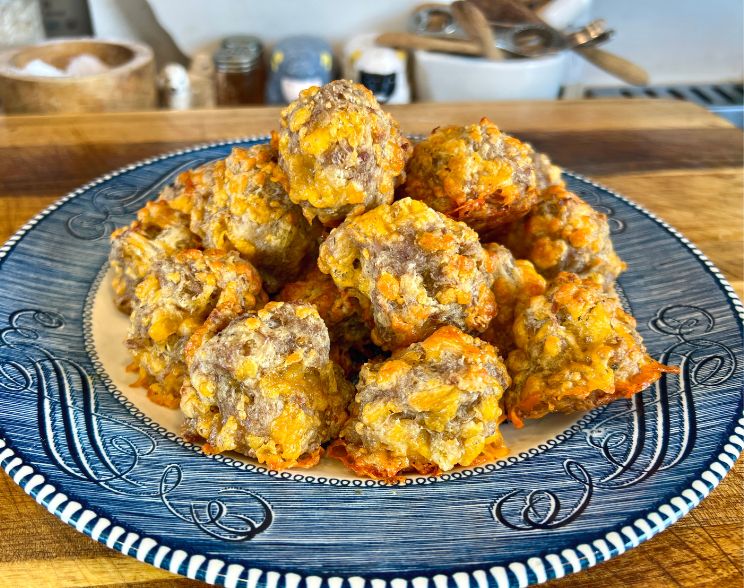
A Holiday Favorite, Made From Scratch
Sausage balls are one of those appetizers that seem right at home on a holiday table. Savory sausage, sharp cheddar, and a little biscuit goodness all rolled into a bite you can pick up with your fingers. There’s a reason people have been making them for generations.
It had been a long, long time since I’d eaten the traditional Bisquick version, but I wanted to bring them back with a homemade biscuit mixture. And these turned out even better than I remembered—soft, tender, and wonderfully moist.
You don’t need a boxed mix to keep a good food tradition going.
A Southern Holiday Tradition
Sausage balls have been a Southern party staple since at least the 1960s, with a particularly strong following around Christmas.
The exact origin of today’s sausage-and-cheddar version is less clear. Bisquick helped make the recipe convenient and familiar, but even the brand’s archivist couldn’t confirm the theory that the company invented it as a marketing recipe.
What has lasted is the combination: seasoned sausage, cheese, and biscuit mixture baked into an easy appetizer. That’s the tradition I wanted to keep.
Why I Make the Biscuit Mixture From Scratch
Replacing Bisquick is much simpler than you might think. Flour, baking powder, salt, and a little cold butter give us the foundation for our homemade biscuit mixture. Then we add the sausage, freshly shredded cheddar, seasonings, and milk.
It takes a few extra minutes to measure those ingredients and cut in the butter. In return, I choose the fat, skip the added sugar in the mix, and leave out added emulsifiers.
This is the kind of scratch cooking I love sharing: taking something familiar and showing that the boxed ingredient is optional.
What’s in Bisquick—and Why I Leave It Out
Making the biscuit mixture from scratch lets me choose the flour and fat, skip added sugar, and leave out added emulsifiers. Here are the ingredients in Original Bisquick that I choose to leave out of my homemade mixture.
Bleached flour
Bisquick starts with chemically bleached flour. Flour manufacturers use bleaching agents such as benzoyl peroxide or chlorine to whiten flour, and some treatments accelerate aging or change its baking properties. I choose unbleached all-purpose flour to avoid that additional chemical treatment. It works beautifully in these sausage balls.
Dextrose and added sugar
Dextrose is glucose, a fast-absorbed sugar that can raise blood sugar quickly—a concern for people managing diabetes. Bisquick also lists sugar separately. Neither is needed in the biscuit mixture for this savory appetizer.
Refined vegetable oils
Bisquick’s vegetable-oil blend may include palm, sunflower, canola, or high oleic soybean oil. Some commercial vegetable oils undergo hexane extraction and high-temperature refining, processes that can leave solvent residues or create unwanted compounds. The package doesn’t identify how its oils were extracted. I prefer to choose my own fat, and this recipe uses butter for flavor and tenderness.
Monoglycerides
Monoglycerides are industrially manufactured emulsifiers added to help ingredients blend and maintain texture. Research has linked higher intake of the broader mono- and diglyceride additive group with increased cardiovascular disease risk. These are optional additives I choose to leave out of my homemade biscuit mixture.
Sodium aluminum phosphate
Sodium aluminum phosphate is an aluminum-containing leavening ingredient used to help baked goods rise. Choosing baking powder labeled aluminum-free lets you make the biscuit mixture without it.
Ingredient lists can change, so check your package. Making these sausage balls from scratch gives you control over the ingredients while keeping a familiar holiday favorite on the table.
Make Them Your Holiday Appetizer
These are easy to pass around before dinner, add to a holiday appetizer spread, or serve while everyone watches the game. Use mild breakfast sausage for a gentler flavor or hot sausage if you like a little heat.
They’re delicious on their own, but my maple-Dijon dipping sauce was the finishing touch. That sweet mustard flavor pairs beautifully with the sausage and sharp cheddar.
For me, this recipe is a keeper. All the comfort of a familiar holiday favorite, with a homemade biscuit mixture that’s easy enough to make every time.
Homemade Sausage Balls Without Bisquick
Ingredients
- 1 pound uncooked bulk pork breakfast sausage
- 8 ounces sharp cheddar cheese freshly shredded
- 1½ cups 180 g unbleached all-purpose flour
- 2 teaspoons baking powder
- ½ teaspoon Diamond Crystal kosher salt
- ½ teaspoon garlic powder
- ½ teaspoon onion powder
- ½ teaspoon ground black pepper
- 2 tablespoons cold unsalted butter cubed
- ¼ cup milk plus more as needed, 1 teaspoon at a time
Instructions
- Heat the oven to 400°F. Line a rimmed baking sheet with parchment paper.In a large bowl, whisk together the flour, baking powder, salt, garlic powder, onion powder, and black pepper.Cut the cold butter into the flour mixture using a pastry blender, fork, or your fingertips until it resembles coarse crumbs with small bits of butter throughout.Add the uncooked sausage, freshly shredded cheddar, and ¼ cup milk. Mix thoroughly with your hands or a stand mixer fitted with the paddle attachment until no pockets of dry flour remain.Squeeze a small portion of the mixture in your hand. It should hold together and roll easily. If it still feels dry or crumbly, add milk 1 teaspoon at a time, mixing after each addition, just until it holds together.Roll into approximately 1-inch balls and arrange on the prepared baking sheet with a little space between them.Bake for 15–20 minutes, checking at 15 minutes, until lightly browned and the centers reach 160°F. Let rest on the baking sheet for 5 minutes before serving.NotesUse mild or hot pork breakfast sausage according to your preference.The salt measurement is for Diamond Crystal kosher salt. If using Morton kosher salt or table salt, use ¼ teaspoon.Serve on their own or with maple-Dijon dipping sauce.StorageTo freeze before baking, arrange the shaped sausage balls on a parchment-lined tray and freeze until firm. Transfer to a freezer bag or airtight container. Bake from frozen at 400°F, allowing additional time, until the centers reach 160°F.To freeze after baking, cool promptly and freeze on a tray before transferring to a freezer bag or airtight container. For best quality, use frozen sausage balls within 2–3 months.Reheat cooked sausage balls at 350°F until the centers reach 165°F, covering loosely to help retain moisture.
