
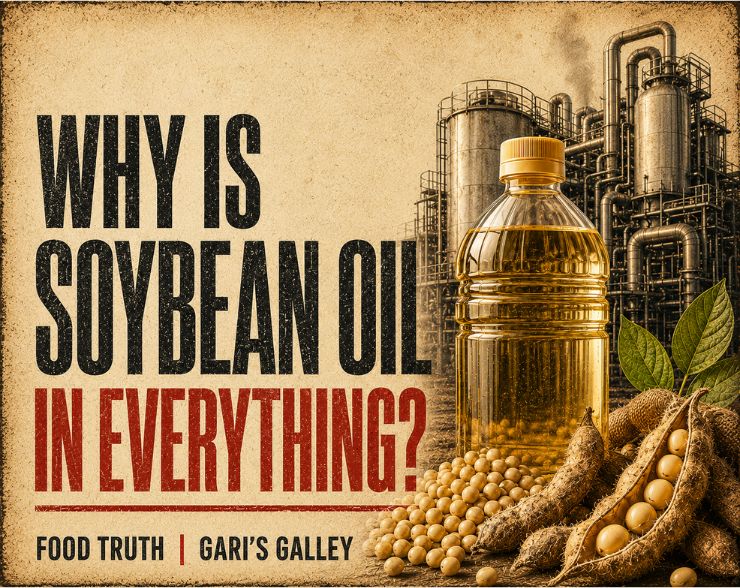
Look at the Ingredient List
Pick up a bottle of mayonnaise, salad dressing, coffee creamer, margarine, crackers, bread, frozen food, or almost anything fried in a restaurant, and there is a good chance you will find soybean oil.
Sometimes it is named plainly. Sometimes it is tucked under the vague phrase “vegetable oil.” Either way, most of us consume considerably more soybean oil than we realize—not because we are pouring it into our skillets, but because food manufacturers put it in almost everything.
Soybean oil is the most widely used vegetable oil in the United States. According to the USDA, it accounts for more than half of domestic vegetable-oil use and appears in baked goods, snacks, mayonnaise, salad dressings, frozen foods, and commercial frying oils.
That did not happen because soybean oil has a remarkable flavor or because cooks spent generations choosing it. It happened because soybeans are abundant, the oil is inexpensive, and manufacturers can refine it into a nearly flavorless fat that works in an enormous range of products.
That makes soybean oil useful to the food industry. It does not necessarily make it the oil I want dominating my diet.
How Soybean Oil Is Made
Soybeans do not surrender much oil simply by being squeezed. They contain considerably less oil than something like an olive or an avocado, so producing soybean oil efficiently requires several stages of industrial processing.
The beans are cleaned, dried, cracked, dehulled, heated, and rolled into thin flakes. Most large-scale processors then use a solvent—commonly hexane—to separate the oil from the soybean flakes. The solvent is recovered and reused, while the remaining protein-rich soybean meal is generally used for animal feed.
The crude oil still contains phospholipids, free fatty acids, pigments, odors, flavors, and other compounds. It is therefore put through additional refining steps that may include:
- Degumming to remove phospholipids and gums
- Neutralizing to remove free fatty acids
- Bleaching with an adsorbent material to remove pigments and trace impurities
- Deodorizing with high-temperature steam to remove unwanted odors and flavors
- Winterizing in some applications so the finished oil remains clear when chilled
Oklahoma State University describes degumming, refining, bleaching, deodorizing, and winterizing as standard steps in edible-oil production.
The word “bleaching” does not mean household bleach is poured into the oil, and the use of hexane during extraction does not establish that a bottle of properly refined oil contains a dangerous dose of solvent. There is no need to exaggerate the process to make it sound frightening.
But it is fair to call soybean oil a highly refined industrial product. By the time it reaches the grocery store, it no longer looks, smells, or tastes anything like a soybean. That blandness is one of the main reasons manufacturers like it.
Why Food Companies Use So Much of It
Soybeans dominate American oilseed production. The USDA reports that they account for about 90 percent of the oilseeds grown in the United States. Crushing the crop produces two commercially valuable ingredients: soybean meal and soybean oil.
That enormous, established supply makes the oil relatively economical and consistently available.
Refined soybean oil also has very little flavor, so it can be added to mayonnaise, cake mix, bread, salad dressing, and frozen meals without making all of them taste like the same oil. It creates moisture in baked goods, carries flavors, helps emulsify sauces and dressings, and works in commercial frying.
In other words, soybean oil is everywhere because it is cheap, plentiful, neutral, and convenient. Those are excellent selling points for a manufacturer. They are not the same thing as nutritional superiority.
It is also important to distinguish today’s soybean oil from the partially hydrogenated soybean oils once widely used in shortening and processed foods. Partial hydrogenation produced artificial trans fats, which are clearly associated with cardiovascular harm. The FDA ultimately determined that partially hydrogenated oils were no longer generally recognized as safe.
Ordinary liquid soybean oil is not the same thing as partially hydrogenated soybean oil and should not be accused of containing large amounts of artificial trans fat simply because older products did.
What Kind of Fat Is in Soybean Oil?
Conventional soybean oil is predominantly unsaturated fat. Roughly half of its fatty acids are linoleic acid, an omega-6 polyunsaturated fat. It also contains approximately 23 percent oleic acid, the monounsaturated fat associated with olive and avocado oils, and about 7 percent alpha-linolenic acid, a plant-based omega-3 fat. The remaining portion is primarily saturated fat.
Both linoleic acid and alpha-linolenic acid are essential fatty acids, meaning our bodies cannot manufacture them and must obtain them from food.
That fact sometimes gets lost in online discussions. Omega-6 fat is not automatically toxic, and the body does need some of it. The more useful question is not whether we should consume any linoleic acid. It is whether an oil supplying a very large amount of it should be the default fat in mayonnaise, dressings, snacks, restaurant meals, and processed food—all at the same time.
There is an important difference between an essential nutrient and an unlimited requirement for that nutrient.
Oxidation Is a Legitimate Concern
Fatty acids containing multiple double bonds are more susceptible to oxidation than monounsaturated or saturated fats. Conventional soybean oil contains a high proportion of polyunsaturated fatty acids, which makes it less naturally stable than oils dominated by oleic acid.
Heat, light, air, and time can accelerate oxidation. Repeatedly heating an oil—as can happen in commercial deep fryers—is especially different from adding a spoonful of fresh oil to a salad dressing.
Oxidation can create a complicated mixture of breakdown products, including aldehydes, peroxides, and polymers. Researchers can measure these compounds, and there is good chemical evidence that highly polyunsaturated oils are more vulnerable to this deterioration.
What we do not yet have is clean human evidence showing that ordinary soybean-oil consumption, by itself, causes a specific disease through oxidation. Much of the alarming material circulated online comes from laboratory experiments, animal studies, or oils subjected to severe heating conditions that do not mirror every use in a home kitchen.
Still, oxidative stability matters. The soybean industry clearly recognizes that because it has developed high-oleic soybean varieties specifically to produce an oil that is more resistant to oxidation and lasts longer during frying.
Conventional soybean oil’s vulnerability to oxidation is real. Claims that every bite containing it is immediately toxic are not.
Soybean Oil and Ultra-Processed Food
One of the biggest problems with studying soybean oil is where we find it.
People are not usually consuming it alone under controlled conditions. They are eating it in French fries, doughnuts, chips, cookies, commercial mayonnaise, packaged bread, frozen dinners, and restaurant meals.
Those foods may also contain refined flour, added sugar, large amounts of sodium, emulsifiers, and excess calories. People who eat more of them may have dietary and lifestyle patterns that differ in many other ways.
That makes it difficult to blame soybean oil alone for every health problem associated with a highly processed diet.
At the same time, its constant presence matters. Soybean oil became one of the primary ways calories were quietly added throughout the modern food supply. You do not have to choose it as a cooking oil to consume it several times in one day.
My concern is not that one tablespoon of soybean oil is going to poison somebody. My concern is that one inexpensive, heavily refined oil has become the default fat in food after food, leaving people with very little idea how much they are actually eating.
What About Genetic Modification and Pesticides?
Most soybeans grown in the United States are genetically engineered, commonly for herbicide tolerance. That raises legitimate environmental and agricultural questions, including herbicide use, resistant weeds, and the concentration of crop production.
Those are not automatically proof that refined soybean oil causes disease in the person eating it.
Highly refined oil contains fat rather than meaningful amounts of soybean protein or intact genetic material. In fact, the FDA exempts highly refined soybean oil from major-allergen labeling requirements because the proteins responsible for most allergic reactions have been removed.
Someone can reasonably object to agricultural practices without pretending that every environmental concern is also direct evidence of human toxicity from the finished oil. They are related conversations, but they are not interchangeable.
Why I Prefer Other Oils and Fats
I do not need soybean oil to be declared poisonous before I decide not to make it the main fat in my kitchen.
For everyday cooking, I prefer fats chosen for the job:
- Extra-virgin olive oil for dressings, sauces, vegetables, and moderate-heat cooking
- Avocado oil when I want a neutral flavor or need higher-heat versatility
- Butter when its flavor belongs in the food
- Tallow for certain high-heat cooking and traditional recipes
- Coconut oil when its flavor and texture work with the dish
These fats are not nutritionally identical, and none should be consumed without limit. I choose them because I prefer their flavors, their cooking qualities, and the fact that I can decide exactly which fat goes into my food.
Extra-virgin olive oil also contains natural flavor and antioxidant compounds retained through mechanical extraction. Refined avocado oil is more processed than extra-virgin olive oil, but it is rich in oxidation-resistant monounsaturated fat and gives me the neutral flavor I want in foods such as mayonnaise.
Butter and tallow contain more saturated fat, so I do not present them as magical health foods. They are simply real cooking fats that I use deliberately, rather than allowing manufacturers to put soybean oil into nearly everything I eat.
The goal is not to worship one oil and fear all the others. The goal is to stop consuming oils by accident.
Mayonnaise Is an Easy Place to Start
Most commercial mayonnaise begins with soybean oil because mayonnaise is primarily oil and soybean oil is inexpensive and neutral.
That means a tablespoon of mayonnaise can contain more soybean oil than almost any other ingredient. If you use mayonnaise regularly, making your own gives you control over the oil, the eggs, the acid, the seasoning, and the final flavor.
Homemade mayonnaise takes only a few minutes with an immersion blender. I use avocado oil because it stays mild enough for mayonnaise while giving me a fatty-acid profile dominated by monounsaturated fat.
Making mayonnaise at home will not repair an otherwise poor diet, and eating commercial mayonnaise once will not ruin a healthy one. It is simply one practical way to replace an oil you did not intentionally choose with one you did.
That is what Food Truth means to me: not fear, not perfection, and not repeating the loudest claim on the internet. It means understanding what is in our food, why it is there, and deciding for ourselves whether we want to keep eating it.
Does Soybean Oil Promote Inflammation?
Soybean oil is high in linoleic acid, an omega-6 polyunsaturated fat. Our bodies need some linoleic acid, but the modern food supply delivers far more of it than people historically consumed—and much of that increase has come from soybean oil.
Short-term human trials have generally not found that adding linoleic acid raises familiar inflammation markers such as C-reactive protein. That finding is frequently used to dismiss concerns about soybean oil altogether, but it answers only one narrow question.
Inflammation is not measured by a single blood test. Those trials do not tell us what happens after decades of consuming soybean oil throughout the day, nor do they fully address oxidized linoleic-acid compounds, metabolic health, repeated heating, or the balance between omega-6 and omega-3 fats in the diet.
Animal research gives us reason not to dismiss those questions. In controlled mouse studies, diets high in soybean oil have produced greater weight gain, insulin resistance, diabetes, fatty liver, inflammatory changes, and altered gene expression compared with diets based primarily on other fats. Mice are not people, and these studies cannot prove that soybean oil causes the same diseases in humans. But when an oil has become the dominant added fat in the food supply, those results deserve investigation—not a shrug.
The honest conclusion is not that every spoonful causes immediate inflammation. It is that the studies commonly used to declare soybean oil harmless do not answer the larger, long-term question.
The Cholesterol Claim Does Not Tell the Whole Truth
For decades, people were told to replace butter and animal fats with vegetable oils because vegetable oils lower cholesterol. That statement became so deeply embedded in nutrition advice that “lowers cholesterol” and “protects your heart” were treated as though they meant the same thing.
They do not.
High-linoleic vegetable oils can lower total and LDL cholesterol when they replace certain saturated fats. That is a change in a laboratory measurement. The outcomes that actually matter are whether people experience fewer heart attacks, fewer cardiovascular deaths, and longer lives.
Some of the largest controlled experiments failed to show those benefits.
In the Sydney Diet Heart Study, men who replaced saturated fats with linoleic-acid-rich safflower oil lowered their cholesterol but experienced more deaths from coronary heart disease, cardiovascular disease, and all causes.
In the Minnesota Coronary Experiment, replacing saturated fat with linoleic-acid-rich vegetable oil also lowered cholesterol. It did not reduce coronary deaths or overall mortality. A later analysis of five randomized trials involving more than 10,000 people found no mortality benefit from replacing saturated fats with oils high in linoleic acid.
These studies did not use soybean oil specifically, so they cannot prove soybean oil causes heart disease. They do expose the enormous hole in the argument used to promote oils like it.
The food industry and public-health authorities focused on the number that improved and treated the promised health benefit as a foregone conclusion. But lowering cholesterol with an oil does not automatically prove that the oil protects the heart.