
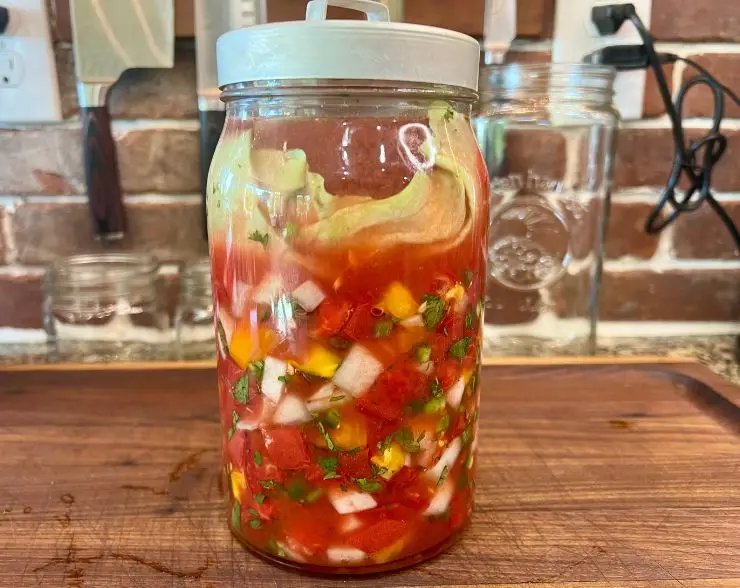
Fermented Salsa
Fermented salsa is a living, probiotic-rich condiment that brings bright flavor and gut-healthy benefits. Unlike canned or vinegar-based salsas, this version relies on natural fermentation. Salt draws liquid from the vegetables and creates an environment where beneficial lactic acid bacteria thrive, preserving the salsa and giving it that pleasant tang.
Equipment
Ingredients
- 6 medium ripe tomatoes, diced
- 1 small onion, diced
- 1-3 jalapeños or serrano peppers, diced (adjust to taste)
- 2-3 cloves garlic, minced
- 1 cup fresh cilantro, chopped
- Juice of 1 lime
- Additive-free sea salt or kosher salt such as Redmond Real Salt or Diamond Crystal, calculated by weight as directed below.
Instructions
- Prepare the vegetables.
- Dice the tomatoes, onion, and peppers. Mince the garlic and chop the cilantro. Place everything in a large mixing bowl with the lime juice.
- Weigh and add the salt.
- Weigh the prepared vegetables and lime juice in grams, excluding the bowl’s weight. Multiply that number by 0.02 to calculate how many grams of salt to use. For example, 1,000 g of prepared salsa needs 20 g salt. Sprinkle the salt evenly over the mixture and stir thoroughly.
- Draw out the brine.
- Let the salted mixture sit for 10–15 minutes, stirring once or twice. The salt will pull liquid from the tomatoes and other vegetables, creating a natural brine.
- Pack into jars.
- Transfer the salsa into clean glass jars. Press down gently with a spoon so the liquid rises above the solids. Leave 1–2 inches of headspace.
- Add extra brine only if needed.
- If there isn’t enough liquid to cover the salsa, dissolve 6 g salt in 1 cup filtered water. This makes approximately a 2.5% water-based brine. Pour in just enough to cover the vegetables.
- Keep it submerged.
- Place a clean cabbage leaf over the surface of the salsa, then add a fermentation weight. The cabbage leaf helps keep small pieces of cilantro, garlic, and peppers from floating around the weight. Keep the leaf and vegetables beneath the brine. Cover with a fermentation airlock or a lid that allows fermentation gases to escape.
- Ferment at room temperature.
- Keep the jars out of direct sunlight at 65–75°F (18–24°C). Begin checking the flavor after about 48 hours, using a clean utensil.
- After about 2 days, the salsa may taste fresh and bright with a subtle tang. As fermentation continues, the texture will soften and the flavor will become more sour. Around 3–4 days may produce a more pronounced tang, although timing varies with temperature and ingredients.
- Refrigerate after fermentation.
- Once the salsa reaches your preferred flavor, move it to the refrigerator. Cold storage slows fermentation but does not stop it completely, so the salsa may gradually become more tangy.
- Tips & Notes
- Salt matters.
- Use an additive-free sea salt or kosher salt, such as Redmond Real Salt or Diamond Crystal. Calculate the salt by weight, since different salts have different crystal sizes and do not measure equally by the teaspoon or tablespoon.
- Cabbage leaf trick.
- A clean cabbage leaf beneath the fermentation weight helps hold the small chopped ingredients under the brine. Keep the cabbage leaf itself submerged, too.
- Fermentation speed.
- Tomato salsa can ferment quickly. Begin checking after about 48 hours and refrigerate once the flavor reaches the level of tang you enjoy.
- Check flavor, not safety, by tasting.
- Taste helps you judge saltiness and tang, but it cannot confirm safety. Discard the entire batch if fuzzy mold develops or it smells rotten. Do not taste a suspect batch.
- Serving ideas.
- Enjoy with tacos, grilled meats, eggs, grain bowls, or simply with chips.
- Storage
- After the room-temperature fermentation period, keep the salsa in the refrigerator. Keep the vegetables beneath the brine and use a clean utensil each time you serve it. Fermentation will continue slowly, and the flavor and texture will change over time. This recipe is not intended for canning or room-temperature storage.
Tried this recipe?Let us know how it was!